Choosing between a petrol and diesel car is no longer as simple as comparing mileage. With rising fuel prices, stricter emission rules, and expensive loan EMIs, you must calculate the total ownership cost, not just buying price.
This detailed guide explains the petrol vs diesel ownership cost India with real numbers, EMI comparison, yearly expenses, maintenance, resale value, and who should buy what—especially if you are a first-time car owner or planning a loan.
In India, petrol cars are cheaper to buy, maintain, and insure. Diesel cars offer better mileage and lower running cost but have a higher price, costly servicing, and lower resale after 8–10 years due to emission norms. Diesel is worth it only for high-running users (15,000–20,000 km/year).
Why Petrol vs Diesel Decision Matters in 2025
You must consider:
- Higher diesel car pricing (₹1–2 lakh difference)
- Rising BS6 Phase-2 maintenance cost
- Shorter resale life due to 10-year diesel limit in Delhi-NCR
- Loan EMI burden increasing due to higher on-road and insurance
- Fuel price gap shrinking in many states
So the question is no longer “which fuel is better?”
It’s “Which option saves more money over 5–10 years?”
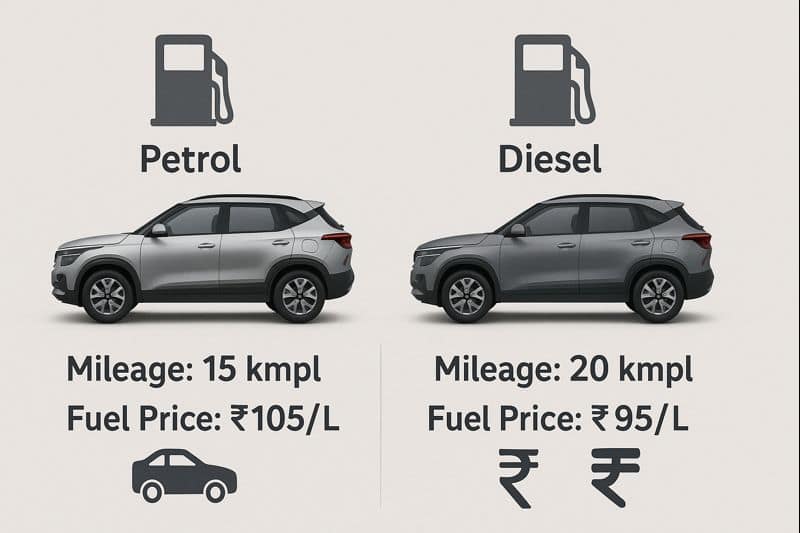
Petrol vs Diesel Price & Mileage Difference in India
Average India 2025 Fuel Prices
- Petrol: ₹105/L
- Diesel: ₹95/L
(Varies by state)
Mileage Comparison (Real-world)
| Segment | Petrol Mileage | Diesel Mileage |
| Hatchback (Swift, i20) | 14–18 kmpl | 19–24 kmpl |
| Compact SUV (Brezza, Nexon) | 12–15 kmpl | 17–21 kmpl |
| Sedan (City, Verna) | 12–16 kmpl | 18–23 kmpl |
Diesel gives 4–6 kmpl more on average.
But mileage benefit must justify higher buying and maintenance cost.
Buying Cost Difference
Diesel variants cost ₹1–2 lakh extra depending on model.
Example (approx on-road Delhi):
| Model | Petrol | Diesel | Difference |
| Hyundai Creta | ₹15.5 lakh | ₹17.2 lakh | ₹1.7 lakh |
| Tata Nexon | ₹10.3 lakh | ₹11.7 lakh | ₹1.4 lakh |
| Venue | ₹10.7 lakh | ₹12.3 lakh | ₹1.6 lakh |
Higher price = higher down payment, insurance premium, and EMI.

Real EMI Example: Petrol vs Diesel Loan Impact
Assume ₹1.5 lakh extra for diesel.
Loan Terms
- Bank: SBI/ICICI typical rates
- Interest: 9%
- Tenure: 5 years
- Down payment: ₹2 lakh
| Variant | Loan Amount | Interest Rate | Tenure | Monthly EMI |
| Petrol | ₹8,50,000 | 9% | 5 years | ₹17,627 |
| Diesel | ₹10,00,000 | 9% | 5 years | ₹20,733 |
Difference
➡ Extra EMI = ₹3,106/month
➡ Extra cost over 5 years = ₹1,86,360
So diesel must recover at least ₹1.8 lakh through fuel savings to break even.
Break-Even: How Many KM Do You Need for Diesel to Make Sense?
Step-by-step formula:
Extra cost of diesel ÷ (Fuel saving per km)
Fuel saving per km example:
- Petrol mileage: 15 kmpl → ₹105/15 = ₹7.00/km
- Diesel mileage: 20 kmpl → ₹95/20 = ₹4.75/km
Saving = ₹2.25/km
Break-even:
₹1,50,000 ÷ ₹2.25/km ≈ 66,600 km
✅ Diesel makes sense only if you drive:
13,000–15,000 km per year for 5 years
Anything below that → Petrol is cheaper.
Petrol vs Diesel Car Maintenance Cost India
Annual Maintenance Comparison (Real-world)
| Year | Petrol Service Cost | Diesel Service Cost |
| 1–3 years | ₹5,000–₹7,000 | ₹7,000–₹10,000 |
| 4–6 years | ₹7,000–₹9,000 | ₹10,000–₹14,000 |
| 7+ years | ₹9,000–₹12,000 | ₹15,000–₹25,000 (injectors/turbo) |
Key differences:
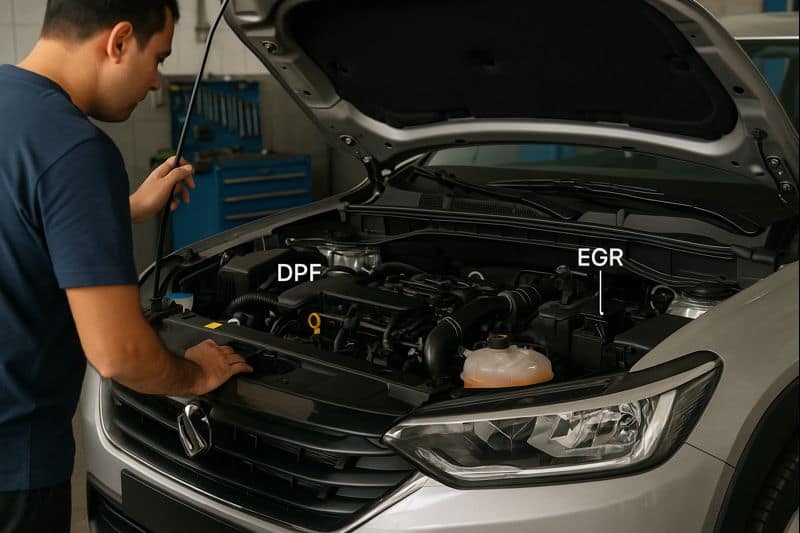
- Diesel has turbocharger, EGR, DPF, injector cleaning
- BS6 diesel needs high-quality fuel
- Risk of DPF clogging in city and short-distance driving
Insurance & IDV Impact
Diesel cars have:
- Higher IDV, so higher premium
- Higher theft risk in some states
- More expensive parts
Average insurance difference:
₹2,000–₹6,000 per year higher for diesel.
Ownership Cost Example (5-Year Calculation)
Car: Compact SUV (e.g., Nexon)
| Expense Type | Petrol (₹) | Diesel (₹) |
| On-road price | 10,30,000 | 11,70,000 |
| EMI difference | — | +1,86,360 |
| Fuel cost (70,000 km) | 4,90,000 | 3,32,500 |
| Insurance (5 years) | 55,000 | 75,000 |
| Service & maintenance | 40,000 | 65,000 |
| Total 5-year cost | 15,15,000 | 17,28,860 |
Result:
Diesel saves ₹1,57,500 on fuel
But you spend ₹2,13,860 more overall
Petrol is cheaper for most Indian users.
City vs Highway Users: Who Should Choose What?
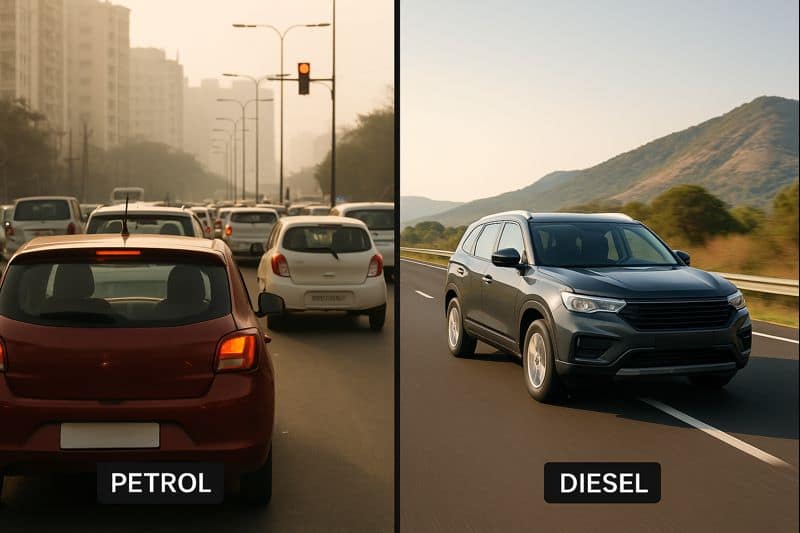
Buy Petrol if:
- Daily running < 40 km
- Mostly city usage
- Live in Delhi-NCR (10-year diesel rule)
- Plan to keep car <7 years
- Want lower EMI and maintenance
Buy Diesel if:
- Drive 15,000–20,000 km/year
- Frequent highways or long trips
- Need strong torque for hills
- Planning to keep car 8–10 years
- Running commercial use (fleet, taxi)
Resale Value Comparison
| Factor | Petrol | Diesel |
| After 5 years | Moderate | Slightly higher |
| After 8–10 years | Better | Drops sharply (NCR ban) |
| Demand trend | Increasing | Declining in cities |
Brands like Maruti, Honda have discontinued diesel for this reason.
Petrol vs Diesel – Which Is Better in India?
For most Indian private buyers, petrol is better because it has lower buying cost, lower EMI, cheaper maintenance, and fewer long-term risks. Diesel only makes financial sense for high-running users who cover over 15,000 km annually.
Pros & Cons Summary
Petrol Advantages
- Lower on-road price
- Lower EMI + insurance
- Cheaper maintenance
- Smoother engine and NVH
- Ideal for city usage
Petrol Disadvantages
- Lower mileage
- Higher running cost for long trips
Diesel Advantages
- Better mileage
- Higher torque for highways
- Fuel savings for heavy users
Diesel Disadvantages
- Higher buying and EMI cost
- Expensive maintenance
- DPF issues in BS6
- NCR 10-year rule impacts resale
Tips Before Choosing Petrol or Diesel in India
- Calculate annual running using:
Monthly km × 12
- If running < 12,000 km/year → Petrol
- Check EMI impact before deciding
- Avoid diesel if you drive only short distances
- Compare insurance premium and IDV
- Check resale trends in your state/RTO
- Maintain CIBIL score for lower loan interest
Conclusion:
If you are the average Indian car owner doing 10,000–12,000 km per year, a petrol car is financially cheaper across EMI, insurance, and service.
FAQs
Q. Petrol or diesel car which is better in India?
A. Petrol cars are better for most private users because they have a lower purchase price, lower EMI, and cheaper maintenance. Diesel cars make sense only if your driving is more than 15,000 km per year and you do frequent highway runs.
Q. What is the petrol vs diesel mileage difference?
A. Petrol cars typically deliver around 14–18 kmpl, while diesel cars offer 19–24 kmpl, depending on the model and driving conditions. Diesel saves money only when annual usage is high.
Q. What is a petrol vs diesel ownership cost calculator in India?
A. It is a tool that compares the total ownership cost over 5 years, including fuel, EMI, insurance, and maintenance, to help decide which fuel option is cheaper based on your yearly running.
Q. Are diesel cars banned in India?
A. No, diesel cars are not banned nationwide. However, in Delhi-NCR, diesel cars older than 10 years are not allowed under NGT and RTO rules, which impacts long-term ownership and resale value.
Q. Is diesel car maintenance cost higher in India?
A. Yes. Diesel car maintenance can be 30–60% higher, mainly due to components like injectors, turbochargers, EGR, and DPF systems in BS6 vehicles.